Very proud that my most critically well-received story, Tears on Vega, has found a new reprint home and now appears for the first time on the internet over with the good people at Digital Science Fiction.
Link Below:
Digital Science Fiction: Tears on Vega
In other news, stay tuned for updates about my work- I am expecting 3 brand new stories to appear in various markets sometime during 2016.
I will provide more details as become available.
Tuesday, March 29, 2016

Tuesday, November 3, 2015
The Exterminator Appears on StarShipSofa!
Was eagerly waiting for this one, but it's now live so I can announce that my Science Fiction short story, The Exterminator, is a featured short on one of the largest Sci Fi podcasts (10k+ subscribers), StarShipSofa.
I didn't hear the final version until it went live and the narrator did a really chilling job voicing the different characters.
My story runs from about minute mark 1:45 until minute mark 11:00

Friday, July 4, 2014
Review: Philip K. Dick's "Martian Time-Slip"
Disclaimer, PKD is one of my favorite authors and one of the all-time greats. His ability to effortlessly world-build, thoroughly distort the reality of the reader and (for the most part) build engaging characters are consistently great. Just needed to get that PSA out of the way.

In this tale set in the nebulously near-future of a Cold War twentieth century, Mars has been colonized. Importantly, the populace of Earth holds the Martian colony on a pedestal as the future of humanity, unencumbered by the petty trappings of Earth. Mars therefore serves as an ironic microcosm of all the worlds' problems which have followed the settlers to Mars, a fact that must be swept under the rug.
PKD weaves an intricate plot of characters who are threaded together by one Arnie Kott, a wealthy union chief who seeks to reap monetary benefit using knowledge of the future. His prophet is a young autistic child with an altered time sense. To help foster communication with the mute child, Arnie enlists his repair man and former schizophrenic Jack Bohlen to build a communication device, and so the tale begins to weave.
The characters are engaging enough to float the narrative, even though some of them are barely more than stock characters. Jack's psyche plays center stage, and probably underscores some of the author's own struggles with mental illness. Given these difficulties, this may not be surprising, and this particular work may have been written by the author for himself as a form of catharsis.
Although it requires some suspension of disbelief given our modern knowledge of the Martian atmosphere and climate, the world building is staggering in its vitality. The novel teems with feelings of capitalistic exploitation, isolation amid the loneliness of frontier life, and ultimately the futility of looking to the stars to escape mankind's failures.
I enjoyed the work overall, but like some other offerings of PKD that I have read, the narrative left me a bit unsatisfied. There was no real punch given by the story's climax. Still, that would not stop me from recommending this work, not just to PKD fans, but to fans of the genre itself. 3.5/5 stars.
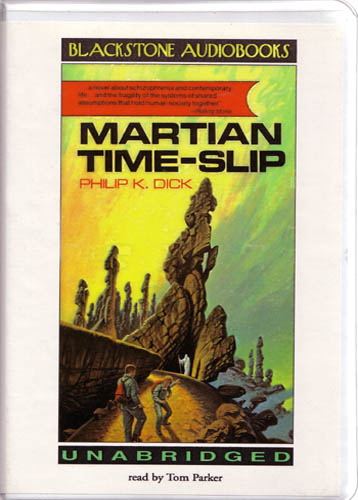
In this tale set in the nebulously near-future of a Cold War twentieth century, Mars has been colonized. Importantly, the populace of Earth holds the Martian colony on a pedestal as the future of humanity, unencumbered by the petty trappings of Earth. Mars therefore serves as an ironic microcosm of all the worlds' problems which have followed the settlers to Mars, a fact that must be swept under the rug.
PKD weaves an intricate plot of characters who are threaded together by one Arnie Kott, a wealthy union chief who seeks to reap monetary benefit using knowledge of the future. His prophet is a young autistic child with an altered time sense. To help foster communication with the mute child, Arnie enlists his repair man and former schizophrenic Jack Bohlen to build a communication device, and so the tale begins to weave.
The characters are engaging enough to float the narrative, even though some of them are barely more than stock characters. Jack's psyche plays center stage, and probably underscores some of the author's own struggles with mental illness. Given these difficulties, this may not be surprising, and this particular work may have been written by the author for himself as a form of catharsis.
I enjoyed the work overall, but like some other offerings of PKD that I have read, the narrative left me a bit unsatisfied. There was no real punch given by the story's climax. Still, that would not stop me from recommending this work, not just to PKD fans, but to fans of the genre itself. 3.5/5 stars.
Friday, June 27, 2014
Vignettes from the End of the World is now live, featuring my story "Tears on Vega"
I am very proud to be a part of this anthology- 58 short tales of the end of the world- each horrifying in their own way.

I recently received an EBook and Print copy, and both look fantastic.
The book is being very well received by critics as well as by those who have bought the book on Amazon and reviewed it.
I was honored that my own piece, Tears on Vega, was the subject of very kind praise in one of these reviews:
A solitary woman on an outpost station on a desolate planet witnesses the tardy visual proof of the apocalypse in "Tears on Vega" by Erik B. Scott. Yes, another favorite. It's beautifully told and glows with grief and loneliness. I could see it all play out in my head: "Her telescope sat at the hill's zenith in lonely anticipation of this day. Lydia was not sure whether the device really was casting humanoid-looking shadows or if it was just her subconscious wishing for some company."
If you are interested in apocalyptic fiction or just want to support me as a writer, I encourage anyone interested to pick up an Ebook copy- you really cannot beat the price!
A solitary woman on an outpost station on a desolate planet witnesses the tardy visual proof of the apocalypse in "Tears on Vega" by Erik B. Scott. Yes, another favorite. It's beautifully told and glows with grief and loneliness. I could see it all play out in my head: "Her telescope sat at the hill's zenith in lonely anticipation of this day. Lydia was not sure whether the device really was casting humanoid-looking shadows or if it was just her subconscious wishing for some company."
Wednesday, May 7, 2014
BLOG HOP ON THE WRITING PROCESS
I’m participating in a
blog hop with other writers in which we answer questions about what and how we
write. Before I answer these questions, I’d like to thank Tom Doyle for
inviting me to participate. I met Tom at an event at the Baltimore
Science Fiction Society and was immediately impressed by his writing. We shared
a mutual love of classic civilizations, and that is reflected in our writing.
Congrats to Tom on his recent book publication, American Craftsmen- find him at
http://www.tomdoyleauthor.com/news-and-blog/
Well, here goes…
1) What am I working on? I currently am working on diversifying
my portfolio of science fiction short stories. I have a special place in my
heart for flash fiction (fiction under 1000 words)- I find the ability to
transport someone to another place and time and do it in under 5 minutes to be
incredibly powerful. I am also working on a feature-length screenplay, entitled
Tantalus. Screenwriting has been a fun experiment for me and has honed my
ability to write dialogue and imagery.
2) How does my work
differ from others of its genre? My work tends to focus on cyberpunk themes
(high tech at the expense of our humanity), as well as themes of what
constitutes humanity and being alien or otherwise alienated. While these themes
are by no means unique to science fiction, I try to set these themes against a
backdrop of space opera. Recently, I wrote a piece of retro Cold War era
science fiction comedy, which I found to be very unique amongst its
competitors.
3) Why do I write what I
do? I often wonder that myself. I tend to write whatever speaks to me, whatever
I am feeling in the moment I set out to write. Given that my work deals with
some aforementioned dark themes, my wife and mother often worry about what dark
thoughts are kicking around in my head. It’s not all doom and gloom, however,
as I have recently branched out into writing science fiction humor. Ultimately,
to use a bit of a cliché, I try to write things that I would like to read
myself.
4) How does my writing
process work? As stated above I write a lot of flash fiction. Given the
considerable time constraints of my day job as a medical student, short writing
sessions of 1-2 hours are generally my norm, and these generally come on
weekends or late at night with plenty of coffee. I sit down to write when I am
struck with a new idea, so I usually know where my story is going when I start-
I have a beginning, a middle and an end in my head. That said, I leave myself
open to course corrections along the way as my characters and my tale unfold
before me. Once finished, I do a few read-throughs to correct any typographic
errors or awkward phrasing/dialogue, and then I am done. This is rather controversial,
but I rarely if ever do rewrites. I try to follow Heinlein’s rules of writing
science fiction, one of which is that you must never rewrite except by
editorial instruction. The thinking goes that the time spent rewriting could
better be spent writing the next story, and I have stuck to it thus far into my
career.
That’s it for now, I will soon be updating shortly to add the
next participants- friends and author colleagues who will be repeating this exercise
on their own blogs!
Thursday, April 10, 2014
Officials Urge Public to Change Locks After Thieves Steal NSA’s Copy of Everyone’s House Keys

Amid swirling public concern regarding internet security breaches and password failsafes, consumer advocates were alarmed to learn Thursday that physical locks may also now be compromised, after reports circulated late Wednesday that hackers had gained access to a secret room where the National Security Administration keeps a key to every home in America. “This is a very serious situation,” said NSA chief General Keith Alexander. “Not only is the security of countless Americans potentially at risk, but this theft has also compromised the NSA’s ability to enter anyone’s house whenever we feel like it.”
Indeed, this key repository has been viewed by many as a cornerstone of the NSA’s spying programs, which infamously gathered meta data on millions of people worldwide. “This key repository greatly facilitated those efforts,” said Gen. Alexander. “Without the ability to enter peoples’ homes, crucial security data on what TV shows people are watching, and what color underwear they like to wear might never have been recorded.”
The hackers perpetrated the bold raid Tuesday night, gaining access to the room with false security credentials, and were able to escape due to an NSA oversight whereby the key to every door in the NSA headquarters was also present in the room.
“We had the thieves contained to one wing of the building,” said Alexander, “But when we breached the wing, we saw that they had simply unlocked the back door and walked out using the key from inside the repository.”
“This room was designated only for storage of the keys of citizen homes,” he went on to add, “And so we are currently investigating this breach of policy.”
“We hope that this incident will raise public awareness about the importance of security,” said Alexander. “If measures aren’t taken to correct these types of problems, soon the public might have to worry that someone other than the NSA has unlimited access to their homes.”
“That is a world that I never want to live in,” the general added gravely.
“We encourage all Americans to be vigilant, but also to change their locks immediately, and to send a copy of the new key to NSA headquarters,” said Gen. Alexander.
He went on to add that the NSA had, for public convenience, already made arrangements to acquire the copied keys directly from the locksmiths, in case anyone forgets to send them in.
(Disclaimer: This has been my first piece of Onion-style satirical, fictional news. I hope you enjoyed it)
Monday, February 3, 2014
Recap: A great event for a great project- DSF Book Launch Party in Baltimore MD
On Saturday, I had the good fortune to be invited to read my previously published story, The Exterminator, at the Daily Science Fiction Book Launch Party at the Baltimore Science Fiction Society in Baltimore MD.
I was part of a cadre of very gifted writers who volunteered to read our works aloud. Below is a group photo at the event.

There was also video taken of my reading at the event. If you ever wanted to experience my fiction in a visual medium, you can find the video here.
Monday, January 13, 2014
What is Success? A Primer (and possibly pep talk) for my Fellow Young Writers
If there is one topic that writers are generally obsessed with, it is success, and it seems to mean different things to just about everyone. Success is a mythical being to some, or taken for granted by others. A lot of writers experience angst about how to "make it" and be a "success."
I do not preach to be an astounding "success" (at least not yet) in the writing world. I consider myself a capable writer, I have multiple professional sales under my belt and other self-published works. But one of the demons that every writer must wrestle with is the self destructive attitude that a quest for success (and an intolerance of failure) can have on the mind of a young writer.
Let me back up, this post came in response to a conversation that I was a part of in a professional writer's group. Some writers were struggling to find what the outside world might consider "success." The discussion centered on the nature of success, and what it means. I added to the discussion, retelling my own personal journey to figuring out what it means to be a success. My words were well-received in the conversation, and so I have structured this post around them. What I said went something like...
Many people define success as monetary success. Your writing becomes insanely popular and puts you on easy street. You know, your George RR Martins, things like that. However, for the vast majority of writers, success comes from a combination of writing money and money from a "day job." The relative contributions of the two may vary, but you can be "successful" as a writer long as you can sustainably do the writing that you love, and keep the rest of your life in order.
Personally, I think that's a great way to look at it. If you love to write, then you are a success as a writer as long as you can do it and take care of your responsibilities.
A problem that writers who are early in their pro careers face is that even a small modicum of success brings higher expectations. I made a somewhat prestigious pro sale of a short story on only the 2nd short story I had ever written, on only the second rewrite of said story, to the first market that I sent it to. That gave me a much higher expectation of myself, and a much lower assumption on the ease of getting published in big markets. It took another year of rejection hell and 6 months of time off due to "writer's block," or more correctly "failing writer's sadness" for me to be able to write again. My expectations had me all out of whack. Turns out, even publishing one story is hard. Almost indescribably hard.
Eventually, I made another small sale, and it upped my confidence again, and suddenly my craft began to improve with the confidence. I was no longer thinking about getting published, I was letting it flow. I took additional comfort in the fact that if you believe the subtext of Heinlein's Rules, then by making a pro sale you are already better off than 99%+ of the people who claim they would like to write. That effort- to write, to edit, to submit, to sell, to be perseverant- is admirable in itself, and a "success." The accolade of being published is just the cherry on top.
However, I am not saying that this laid back attitude about success is a license to accept mediocrity. I think we all owe it to ourselves to be honest with our benchmarks, and never be satisfied. To be hungry is healthy. The trick is just to avoid the self destructive behavior that feeling a failure can bring to one's psyche and careers.
Tuesday, January 7, 2014
Time to party! Book release party, that is. I will be doing a live reading!
I am happy to report that I was recently invited to read aloud my first pro sale, The Exterminator, at an upcoming event for the magazine in which it was published, Daily Science Fiction.
Daily Science Fiction Book Release Party "Rocket Dragons Ignite: DSF Year Two"
They are releasing their latest anthology which I feel is one of the best values in all of sci fi. You get over 200 stories in the huge volume for a very reasonable price.
I look forward to meeting any fans of the magazine, as well as my fellow authors who will be attending this event! Details are in the link above.
Monday, January 6, 2014
Teaser Spotlight: Upcoming Publication
Want to read more of work by @Erik_B_Scott ? A work of my flash fiction will appear in upcoming themed anthologies. Publication details to follow!
Thursday, October 31, 2013
Lava planet, and the trope of the certain nature of death/entropy.

The astronomy world (and my facebook feed) was all atwitter today regarding the discovery of a new world. Kepler-78B is 400 lightyears away, and possesses extreme temperature conditions and a surface composed of molten rock (lava) due to its miniscule distance from its sun. In fact, it is so close to its sun that it completes its orbit completely in about 8.5 earth hours.
But it is this proximity that also signs the planet's death warrant. Like a terminal patient, this proximal orbit will, according to astronomers, eventually cause the planet to be drawn towards and eventually become engulfed by the sun.
This planetary fate stirs many emotions in me as a writer of speculative fiction. Something about situations of certain death stir within me feelings of the inevitability of not only my own demise, but also of the universe itself. You can't beat entropy.
This concept is far from a novelty in science fiction. Isaac Asimov wrote one of the most famous treatments of the certain death of the universe due to entropy, in a story titled The Last Question. This story, and its twist ending, is my single all-time favorite science fiction story.
I like stories like this because although there is something undoubtedly scary about certain doom, entropy or human mortality, there is also beauty. The universe, and indeed life itself, are spectacular, precious and limited. Instead of fearing inevitable demise, use it as an opportunity to cherish what you do have.
Back to Kepler-78B, I wish the planet well and sincerely hope that it can escape its unhappy fate. Hopefully, whatever unusual form of life is living amid the lava of that world shares this sentiment and wishes us well amid our own inevitable demise.
Wednesday, October 30, 2013
Ecclesiastes 1:9. Nothing new under the (spec fic) sun.

I don't delve into matters of religion very often- I am somewhat theologically neutral, despite a Catholic upbringing. The biblical verse quoted in the title above is not meant to preach. On the contrary, it is meant to draw attention to the preaching that is being done by some editors to myself and other authors.
For those that have no idea what I am talking about, Ecclesiastes 1:9 reads as follows:
That which has been is what will be, That which is done is what will be done, And there is nothing new under the sun.
This quote about nothing new under the sun is remarkable given that it was written thousands of years ago. If there was nothing new in biblical times, then surely there can be nothing new now, right?
The short answer, when it comes to science fiction, is: well, yes and no.
On the one hand, most if not all plots have been done before. I'm sure you have heard it said that there are only X numbers of possible plots, and every story out there is a variation on one of those themes (I use the variable X because the number varies depending on the source). A popular episode of Southpark brought this fact to a satiric climax, as anything that episode attempted to do, The Simpsons had already done. Simpsons Did It!
This has led to some frustration on the part of writers, who are constantly challenged to be new, fresh, different. I began writing this post as a reaction to the words of an editor (of an SFWA market) who told me that my premise was not new and in fact had been done before. He said that even if my story was the most technically sound he had ever read, he would not buy it because the premise aired on a Star Trek episode 30+ years ago.
But therein lies the rub.
Literature, especially science fiction, has to be new, has to be exciting and different. It is a genre that pushes the boundaries of humanity and the very possibilities of the universe. But that does not excuse this fiction from the immutable law posited by Ecclesiastes 1:9. Just because we have to push boundaries and be novel, that does not mean we can do something that no one has ever done before in all aspects.
So when an editor sees a story and says "Gee, I've seen that story where the guy walks on Mars 1000 times- REJECT," he is ignoring the possibility of new twists on an old theme, or even the artistic rendering of a tired theme that makes it new in and of itself.
Still, it is an Editor's prerogative to publish interesting pieces, and so true innovation indeed has to be rewarded. But an editorial hard stance against using certain tried and true themes, regardless of their technical competency, emotional depth or other factors that make great fiction, seems a bit short-sighted to me.
Thursday, October 24, 2013
EBook Preview: My new novella entitled "Genesis" now live on Kindle!
I could not be more proud to announce that my latest EBook (a novella), entitled Genesis, is now available on Kindle and Amazon.

From the time he was a child, Dr. Ludlow dreamed of unraveling the mysteries behind the creation of life. As an adult he became one of the most respected researchers on the very same topic. However, life throws him a curveball, and a dissolved marriage and subsequent nervous breakdown leave his career, and his dream, in ruins... until...
The military offers him a chance at redemption: The Chronos Project. New technology allowing scientists to go back in time to study early events in human history. Who better to send back to study the origins of life than the world's foremost expert on the subject, regardless of any issues? But when the mission goes awry, did Ludlow's mental problems follow him into the past?
What is creation? Who is God? What is real and what is not? These are some of the big questions addressed by Genesis, a powerful novella that not only tells the story of Ludlow's journey but also posits its own creation mythos.
Wednesday, October 23, 2013
Zine Plug: Eretz Songs
Old friend Steven Gordon has spun off his very popular blog into a new market for science fiction poetry, entitled Eretz Songs.
Science Fiction poetry is not what most people think of when they think about the genre, but it can convey just as such powerful images of future darkness (or light) as prose.
The current issue's poetry is a quick read skimming the surface, but there is a lot of rich, deep substance. I don't profess to be a poet, but evocation of emotion is the goal, and these hit the mark.
So if you are curious about a robot's perception of the changing of seasons, or of forced marriage of a not-so-perfect perfect mate, check it out.
Monday, October 21, 2013
Review: Bridesicle by Will McIntosh
I recently took my new bride on a romantic evening/overnight in Atlantic City. The morning after, as we lounged in the Borgata's spa, I finally got to cross off some titles from my reading list. I brought out the 2010 Nebula Award Showcase, and read some of the nominated shorts. Bridesicle was one of my reads, and it was a powerful experience, and perhaps strangely apropos being a newlywed.
The story's name derives from its main premise, which becomes pretty clear in the first few words (so no spoilers here): women who are killed at an untimely young age are cryogenically frozen, and technology exists to revive them. But there is a catch: the technology is expensive, and so to get brought back to life, the women must convince rich male benefactors to marry them. Our protagonist faces an uphill battle in that regard, because she is (unbeknownst to her potential suitors) a lesbian.
This rather twisted environment really makes for an emotional ride. You can feel the revulsion as the sleazy men coerce the women into marriage; you can feel the desperation as the main character clings to life. Eventually she even compromises her ideals, and even her identity, to try to convince a man that she is something that she isn't, only to survive. This do-what-it-takes survival instinct trope is not new, but the implementation of it in this situation certainly was.
It begs the question of the reader, would you pretend to love someone if it was your only means of survival? I think most of us would be much happier never knowing exactly what we would do to survive.
My humble review will seem small potatoes compared to the awards and critical acclaim this work has already won, but I highly recommend it.
If you are further interested, apparently the premise was expanded into a novel "Love Minus Eighty" by the same author.
Thursday, October 17, 2013
Critical Acclaim for my flash fiction piece "The Exterminator" by Erik B. Scott
Hey guys,
In speaking to my absence- I can only plead insanity... because I was insane enough to get married! The whole thing was fantastic, but (understandably), other responsibilities cut into my writing. I am now back on the grid and back doing what I enjoy- producing fiction.
Back to business.
I am proud to say that Professional Science Fiction Writer and Editor Frank Dutkiewicz (Daily Science Fiction, Unidentified Funny Objects) over at Diabolical Plots has posted a review of my flash fiction, The Exterminator (first published in Daily Science Fiction).
Their review, which can be found here, is copied below (note, that at the time of this posting, their website seems to be having issues).
"Jaren is called in by a Morgat overlord to rid his residents of unwanted pests in “The Exterminator” by Erik B. Scott (debut 1/17 and reviewed by Frank D). Jaren is loyal servant to the overlord race. His attempts to become a bigger influence in their occupation had fallen short so a role as an exterminator is the best he can hope for. A belief that his loyalty and dedication may improve his lot is what he relies on, and if that means ridding his own world of unwanted pestss, then so be it.
“The Exterminator” is set on an Earth that has fallen to alien invaders. Jaren is a product of a world that has already succumbed. He is eager to fit in, but always knows that he never will. Although the twist to piece was obvious from the start, I was really taken in with the premise and with its characters.
Recommended." -Frank Dutkiewicz
Thanks for reading my work and giving feedback, I was happy that you enjoyed it.
Saturday, April 27, 2013
Review of Paradise Left by Evan Dicken, Published on Daily Science Fiction
Who doesn't love the singularity?
No, I don't mean a wormhole, Bajoran or otherwise. I mean the AI singularity. Although the singularity does not have one definition, I will attempt a rough explanation here. For the uninitiated, the singularity is the concept whereby technology, which is advancing at an exponential rate, will reach a point where technology surpasses human intelligence, and then continues to advance. After that point, it is impossible for humans to predict the outcome, and some have postulated that human affairs as we know them cannot continue. Based on some estimates, the singularity may in fact be sooner than we think.
So what does this have to do with the review at hand? (Warning, some spoilers are ahead).
The short story, which can be found here, portrays human life after the singularity. AI has reached unimaginable heights, and thus has formed a sort of nanny state, watching out for all humans, at the cost of their sovereignty over their own affairs.
The narrative focuses on a marital dispute which fleshes out the underlying issues of this brave new world. The wife is a fighter for mankind's independence, conflicted and possibly misguided, striving against utopia in the pursuit of freedom. This raises some interesting issues as to the actual nature of freedom (i.e. the people are free to do what they want, but are under the benevolent oversight of the AIs).
Ultimately, the resistance fighters decide to leave the homeland to break free of their robot shackles. However, the final lines of the stories foreshadow that, like in Asimov's "The Last Question," their problems will still follow them. Speaking of Asimov, this piece also borrows from Asimov's I Robot in some ways, at the expense of some originality.
Overall, this take on a "dystopian utopia" was interesting, as was the nature of the "war of resistance." However, the actual delivery of the plot, and the climax that it built to, lacked punch for me.
Overall, I give this piece 3 stars out of 5. "Good."
Market Highlight: Unidentified Funny Objects
I have never really written any form of humor stories. I enjoy comedies in theater and the movies, so on some level it seems like a natural fit. However, I always find my sci fi turns into "doom and gloom" stories. Also, it is exceedingly hard to write comedy, as what sounds funny in your head might just be boring in the mind of another.
However, I recently became aware of an anthology which specifically publishes humorous science fiction stories, Unidentified Funny Objects. I highly recommend this for light reading, and look forward to this year's edition.
I am proud to say that I recently completed a story, entitled "A Relative Hangover" for submission to this anthology. Fingers crossed!
Wednesday, April 24, 2013
Critical Reviews for my work entitled The Exterminator
This post is actually a long past-due recognition for a colleague, Steven Wittenberg Gordon, who was kind enough to share his thoughts on my first professionally-published work, The Exterminator. The review can be found by clicking here (Flash fiction requires a flash review!). The link connects to his excellent blog, entitled Songs of Eretz, where you can read more about the author, his work, and his critical reviews of other works.
The story itself can be found here, where it was originally published, in Daily Science Fiction: The Exterminator by Erik B. Scott.
Thanks for taking the time to look at my work, Dr. Gordon!
The story itself can be found here, where it was originally published, in Daily Science Fiction: The Exterminator by Erik B. Scott.
Thanks for taking the time to look at my work, Dr. Gordon!
Monday, April 22, 2013
Inaugural post, and Film Review of Tom Cruise's Oblivion
Hello and welcome to my blog. I am a relative newcomer to the professional speculative fiction writing community, but I have thus far certainly been enjoying the ride. I plan on using this blog as a forum to express my thoughts on what I read, write and watch, as well as to communicate with readers and fellow authors. I am very responsive to posts and emails and love to hear from fellow sci-fi lovers.
Without further ado, I will break into my first actual content piece: a brief review of Tom Cruise's Oblivion (contains some spoilers):
I went into this movie with low-to-moderate hopes. Big-budget sci fi has largely been a mess lately, and I'm still getting over the gut-punching hope-dashing that Ridley Scott gave me in last year's Prometheus. I'm also admittedly not a huge Tom Cruise fan. So, I went into the movie with my share of biases, but despite all of this, I can admit that I left the movie theater entertained.
That is not to say that Oblivion is a great, or even a very good, film. Indeed much of it was derivative, prompting one reviewer, Tom Charity, to say: "If you poured all the most memorable sci-fi films from the past half century into a blender, from "2001: A Space Odyssey" and the original "Planet of the Apes" all the way down to last year's "Prometheus," you would probably wind up with something very similar [to Oblivion]."
While I admit that I did notice the numerous tropes and concept-borrowing that Charity is alluding to, I did not find that, overall, this movie was a derivative experience. Importantly, I left the theater WITHOUT the feeling that I had seen this exact movie before (and that's a good thing).
The plot focuses around a team of technicians stationed on a post-apocalyptic Earth. They are tasked with defending the machinery that mankind is using to relocate to a new celestial home, now that mother Earth is no longer hospitable. In their way stand remnants of the alien forces that decimated Earth in the first place. Not a bad post-apocalyptic setting, and not one that I've seen before.
The film's opening acts are fairly slowly-paced, and I found myself wishing that things would just get where they were going. Once the plot ramped up, though, the pacing markedly improved. The movie's trailers spoil one of the film's major plot twists, so I went into it with the "I see all this coming," mentality. However, the film also delivers a pretty strong twist about two-thirds of the way through that turns is all on its head, and I most assuredly did not see it coming.
Action sci-fi fans will likely be underwhelmed by the overall lack of "shoot-em-up" sequences, but since this is not my taste anyway I found the action sequences that did appear were overall both exciting and appropriate.
It was not all peaches and cream, though, as I was also plagued by several instances where I was unable to achieve suspension of disbelief. These moments were mostly concerning the motives of the antagonist in the final movement of the plot. They seemed a bit far-fetched. Additionally, a plot arc introduced late in the movie just did not work for me (spoiler alert) surrounding the introduction of clones.
Overall, Oblivion is a fair film, one that I do not regret watching but that I would be hard-pressed to watch again. I give this film a 6.5/10, which is perhaps a bit higher than most critics will allow, but I appreciated the ambitious scope that the movie attempted to capture, and gave some bonus points for creating an overall original experience (tough to do in today's derivative movie industry).
-Erik B. Scott
Subscribe to:
Posts (Atom)